
Caribbean Holiday and Festival Foods
Caribbean Holiday and Festival Foods: What's on the Table for Every Celebration Food is inseparable from Caribbean celebrations. Every major holiday, festival.
Caribbean Holiday and Festival Foods: What's on the Table for Every Celebration
Food is inseparable from Caribbean celebrations. Every major holiday, festival, and life event comes with a specific set of dishes that have been prepared the same way for generations. These foods carry memory, identity, and community — to eat them is to participate in something much larger than a meal.
What Do Caribbean People Eat at Christmas?
Christmas is the biggest food occasion of the Caribbean year, and preparations begin weeks in advance.
Black Cake (Rum Cake)
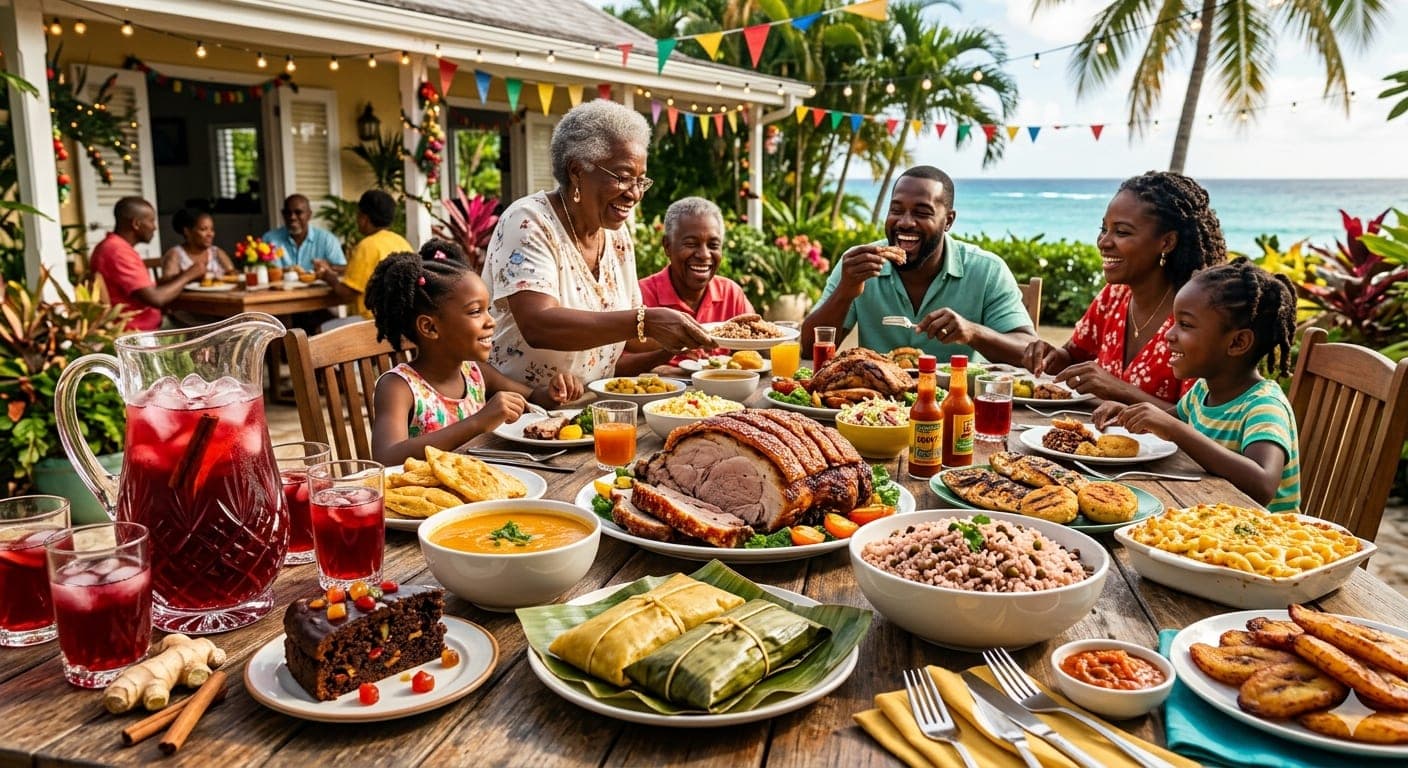
No Caribbean Christmas table is complete without black cake. The process begins months ahead: dried fruits — prunes, raisins, currants, cherries — are submerged in dark rum and cherry wine and left to macerate. On baking day, the soaked fruit is blended into a smooth paste, folded into a rich batter with brown sugar, butter, eggs, and warm spices (cinnamon, nutmeg, allspice, mixed essence), then baked low and slow until deeply dark and moist. The finished cake is fed with more rum and wrapped in wax paper to mature. Black cake is given as gifts, served to guests, and present at every gathering throughout the season.
Sorrel Drink
The dried red calyces of the sorrel plant (hibiscus sabdariffa) are steeped with ginger, cloves, and cinnamon, then sweetened and usually spiked with rum. The resulting drink is tart, jewel-red, warmly spiced, and utterly Caribbean. It's made in large batches at Christmas and shared generously — the sight of a jug of sorrel means the season has officially arrived.
Ham and Gungo Peas Soup
A glazed ham is the Christmas centerpiece across many islands. In Jamaica, gungo peas (pigeon peas) are freshly harvested at Christmas, making gungo peas soup — a hearty soup of pigeon peas, yam, dumplings, and salted pork — a seasonal delicacy. The soup is eaten on Christmas morning, often before presents.
Pastelles (Trinidad and Tobago)
Pastelles are Trinidad's Christmas food par excellence — small parcels of seasoned cornmeal filled with spiced minced meat, olives, capers, and raisins, wrapped in banana leaves and steamed. The process of making pastelles is communal — families gather for "pastelle-making parties" where everyone assembles line after line of the parcels. Eating a pastelle is eating Christmas in Trinidad.
What Do Caribbean People Eat for New Year's?
Joumou Soup (Haiti)
Haiti's joumou soup is one of the most historically powerful foods in the Caribbean. Pumpkin (joumou) soup was forbidden to enslaved Haitians by French colonizers who reserved it for themselves. When Haiti became the first free Black republic in 1804 after the revolution, joumou soup was eaten on January 1st in defiance and celebration — a tradition maintained every New Year's Day ever since. The soup is rich with pumpkin, beef, root vegetables, pasta, and warm spices. In 2021, UNESCO inscribed joumou soup on its Intangible Cultural Heritage list.
Black-Eyed Peas
Across the Caribbean and the African diaspora, black-eyed peas eaten on New Year's Day are believed to bring good luck and prosperity in the coming year. The tradition connects to West African practices brought over through the slave trade and is observed with variations from Jamaica to Barbados to the American South.
What Foods Are Eaten at Carnival?
Caribbean Carnival — celebrated most famously in Trinidad (just before Lent), Barbados (Crop Over in July/August), and Jamaica (August) — comes with its own food culture.
Doubles and Street Food (Trinidad Carnival)
Carnival in Trinidad means street food around the clock. Doubles (curried chickpea flatbread sandwiches), corn soup, phoulorie (fried split pea fritters), and bake and shark fuel the revelry. Vendors line the streets from dawn through all-night fetes, and eating is as much a part of Carnival as costume and music.
Flying Fish Cutters (Barbados Crop Over)
During Barbados's Crop Over harvest festival, flying fish cutters — sandwiches of fried flying fish in salt bread rolls with pepper sauce and lettuce — are essential festival eating. Flying fish is Barbados's national dish, and Crop Over is the moment when it is celebrated most enthusiastically.
What Is Eaten at Caribbean Weddings and Life Events?
Curry and Roti (Indian-Caribbean Weddings)
In Trinidad and Guyana, large weddings serve curry — goat, chicken, or duck — with dhalpuri roti and rice. Cooking for hundreds of guests is a communal undertaking, with massive iron pots (deghis) set over open fires the night before. The scale and communal effort is as much a part of the celebration as the ceremony itself.
Oxtail and Rice and Peas (Jamaican Celebrations)
Oxtail — slow-braised until fall-off-the-bone tender with butter beans, allspice, thyme, and scotch bonnet — is the prestige dish of Jamaican celebrations. It takes 3–4 hours of patient cooking and signals that no expense has been spared. Served over rice and peas, it's the dish guests remember long after the event.
Sancocho (Dominican Republic Celebrations)
Sancocho is the Dominican party stew — a massive pot of multiple meats (chicken, beef, pork, goat), corn, plantains, root vegetables, and herbs simmered for hours. It's eaten communally from shared bowls at family gatherings, birthday parties, and any occasion where people come together in large numbers. A proper sancocho is a point of pride and an act of generosity.
What Are Traditional Caribbean Festival Foods (Fairground/Street Fair)?
- Festival (Jamaica) — slightly sweet fried cornmeal dumplings, eaten alongside jerk chicken and fish at festivals and cookouts
- Corn soup (Trinidad) — thick, sweet corn soup with dumplings, served in cups from street vendors at late-night events
- Roasted corn — grilled over coals, slathered with butter and seasoned with salt and pepper, a universal Caribbean street food
- Sugar cane — fresh-cut cane is chewed for its sweet juice at festivals and markets
- Snow cones (raspados/shave ice) — shaved ice drenched in bright fruit syrups — tamarind, passion fruit, mango — a beloved cooling treat at outdoor events
Caribbean festival food is inseparable from music, community, and joy. These dishes are eaten standing up, with fingers, from paper bags and banana leaves — food at its most social and its most alive. To eat at a Caribbean festival is to understand that the cuisine is not just about sustenance; it is about belonging.
Comments(0 comments)